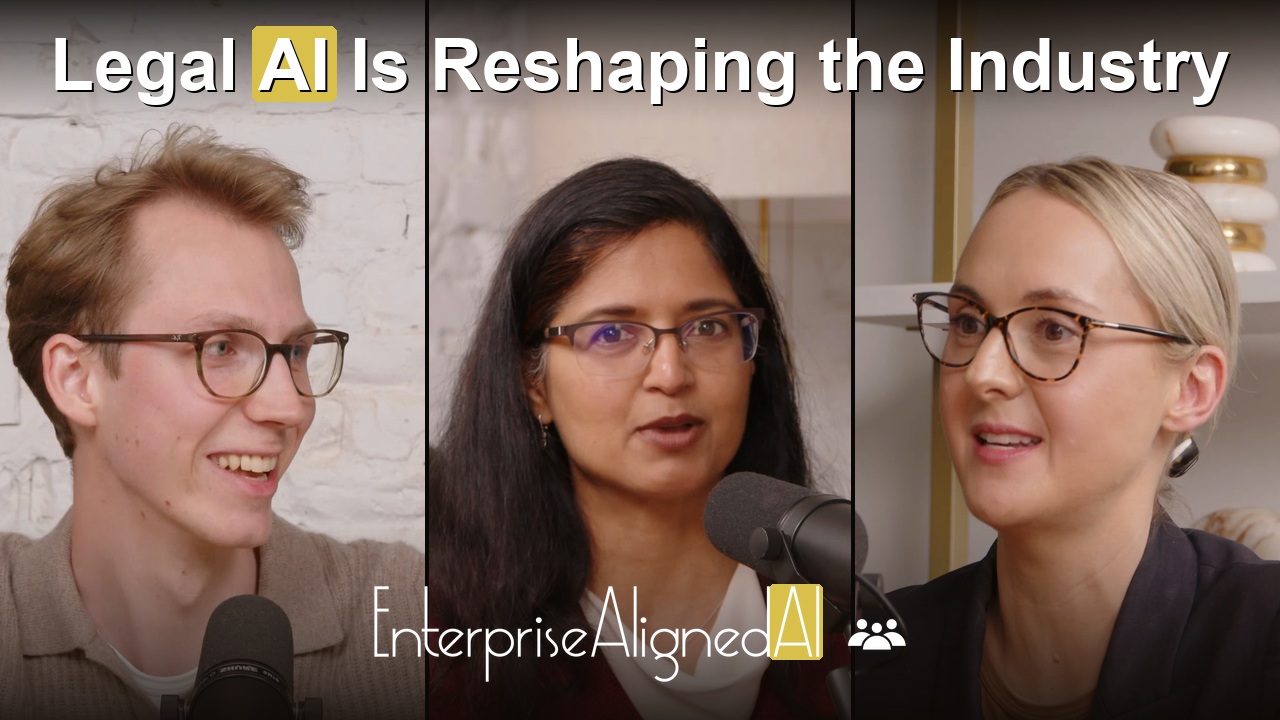
Who owns the AI harness inside a law firm? And what happens to the billable hour when AI enables everyone?
Enterprise AI usage for legal work is surging with 79% of lawyers now using AI (up from 19% two years ago)1. Legal is not just an early adopter, it’s a bellwether for all knowledge work. A sampling of the questions now facing the legal profession:
- Does AI change the billable hour pricing model for Law Firms?
- What is the role of legal expertise and judgement and how best to apply it?
- How can legal tech startups differentiate themselves from model providers?
- Where does it not make sense to use AI in legal?
- Should lawyers build technical skills?
In this episode of Enterprise Aligned AI, I sat down with two incredible leaders tackling these questions: Max Junestrand, CEO and Co-founder of Legora, and Danielle Benecke, Founder and Global Head of Baker McKenzie’s Applied AI practice.
- Legora: Founded in Stockholm in 2023, Legora is one of the fastest enterprise software companies in history to reach $100 million in ARR, hitting that milestone in just 18 months. Valued at $5.6 billion this spring, Legora now serves over 1,200 legal teams.
- Baker McKenzie: A 77-year-old firm and more global than most peers, with 70+ offices worldwide. Danielle leads a specialized unit of lawyers and AI technologists building custom AI systems directly for multinational clients.
Key Takeaways from the Conversation
- The Business Model Shift: Legal are 95% human delivered services and 5% software today. Max and Danielle explain that this ratio is shifting rapidly and has broad implications. They explain why Legora moved to consumption-based pricing, while Baker McKenzie is leaning into fixed-fee models over billable hours.
- Expertise should move upstream: Because generating a first-draft legal analysis is now cheap and fast, human judgement and accountability are the scarce assets. Danielle’s team pulls human judgement into designing AI architecture and guardrails upfront rather than mechanically validating AI output line-by-line downstream. Clip
- Work that could not be done before: The prize is not doing today’s work faster. Danielle’s team now delivers same-day analysis of reporting obligations during a live cyber incident, work that used to take days or weeks before AI. She argues the industry should focus on the services that do not exist yet rather than accelerating the ones that do. As AI generated output proliferates this becomes urgent. Clip
- Differentiating via the Harness and Operating System: Max gives his insights on building a winning product: the harness is the orchestration layer that determines which documents the model reads, resolves conflicts between court precedent and internal firm playbooks, chooses which models run where, and manages sub-specialization. Clip
- When to Own vs. Rent: Danielle shares a rule that generalizes beyond law: Own the harness where the workflow hinges on your unique institutional expertise, playbooks, and strategic edge. Rent it where the capabilities are general or standardized.
I ranked the five moats vertical AI companies can build in a Stanford CodeX paper with Jay Mandal. This episode adds a great deal of depth to that work.
Join the Conversation
Whether you are an enterprise executive, in-house counsel, or AI practitioner, this debate provides a practical blueprint for navigating build vs. buy decisions and structural pricing shifts in agentic AI.
If you know a legal or enterprise leader currently deciding what to build and what to buy, pass this post along to them!
📖 Full episode with timestamps, key takeaways, and show notes.
Footnotes
-
Source: Clio Legal Trends Report ↩
Related Articles
Inside the State of AI Transformation: Insights from 100+ Top Tech Executives
Anna Jacobson, Partner and Chief AI Enablement Officer at Operator Collective, walks through a survey of 123 senior operators implementing AI. About 70% have no formal way to measure AI's impact, AI-native companies push accountability down to every employee, and executives adopt chatbots at the same rate as their companies while using specialized tools far less.
Read articleHow Coursera Became an AI-Native Enterprise
Coursera is a fourteen-year-old public company that transformed itself to the leading edge of AI. CTO Mustafa Furniturewala and Mint MCP founder Jiquan Ngiam break down how an established enterprise becomes AI-native: enablement, culture, and automation.
Read article